Table of contents
-
Why live commerce is the highest-conversion sales channel in jewelry right now
-
What makes jewelry live commerce work when traditional ecommerce struggles
-
The 5-part live commerce workflow independent jewelers are running
-
Part 1: Pre-show catalog capture and prep
-
Part 2: The live show itself
-
Part 3: Post-show follow-up and conversion
-
Part 4: The between-show catalog and content engine
-
Part 5: The lifestyle and model imagery that closes the ecosystem
Live commerce for jewelry is quietly becoming the highest-conversion sales channel in the category. Independent jewelers running the format consistently are reporting conversion rates of 40 to 70 percent per live show, which sits an order of magnitude above traditional ecommerce jewelry conversion rates that typically fall between 1 and 3 percent.
That number is not a marginal improvement. It is a category shift. And most independent jewelers still have not tried it.
The reasons are the ones you would expect. It looks time-consuming. It feels performative. The tech setup seems complicated. Most independent jewelers do not know where to start. So the channel that is generating outsized conversion for the retailers who do run it stays wide open for the retailers who are willing to move first.
This guide walks through why live commerce for jewelry works, the 5-part workflow independent jewelers are running to make it operationally feasible, and where the tools fit for retailers who want to build the channel this quarter.
Why live commerce is the highest-conversion sales channel in jewelry right now
Three structural reasons live commerce is delivering conversion rates traditional ecommerce cannot match.
Reason 1: The trust gap is closed in real time. Industry data confirms live commerce models for jewelry retail are generating conversion rates of 40 to 70 percent, significantly outperforming traditional ecommerce traffic. The customer buying jewelry online typically hesitates because they cannot inspect the piece, cannot verify the seller, and cannot ask questions without a delay. Live commerce solves all three at once. The customer sees the piece close-up on video, hears the jeweler describe it, and asks questions in real time. Twenty minutes of live interaction replaces weeks of email back-and-forth.
Reason 2: The urgency mechanism is built into the format. Live shows have a start time, a duration, and a stock count. Every piece shown is available now, at the price stated, until either the show ends or the piece sells. This is a natural urgency loop that traditional ecommerce has to manufacture with countdown timers and low-stock warnings. In live commerce, the urgency is genuine, and the customer feels it.
Reason 3: The community effect compounds. Live commerce viewers watch other viewers buy. They see the comments. They see pieces sell out in real time. They see the jeweler recognize repeat customers by name. This is the same psychological mechanism that powers auction dynamics and retail rush moments, and it does not exist in traditional ecommerce.
Together, these three mechanisms explain the 40 to 70 percent conversion rate. It is not a fluke of the medium. It is the medium producing the exact conditions that jewelry historically required in-store presence to deliver.

What makes jewelry live commerce work when traditional ecommerce struggles
Jewelry is a considered purchase. High price point. Emotional weight. Difficult to inspect remotely. Traditional ecommerce has spent 20 years trying to solve these problems with better photography, more angles, more video, and higher-quality product pages. Live commerce solves them differently. Instead of building a better static representation, it removes the static barrier entirely and puts the customer in a live conversation with the piece and the jeweler.
Three specific jewelry categories where live commerce is performing best right now:
-
Colored gemstones. The customer needs to see the actual color in motion, in different light, from different angles. Live video does this in ways static photos never can, especially for stones like opals, tourmalines, and untreated sapphires where color varies dramatically.
-
Vintage and estate pieces. One-of-a-kind pieces where the customer needs the story, the provenance, and the condition report in real time. Live commerce is the best possible format for pieces that will not exist anywhere else.
-
Custom and made-to-order. Live shows where the jeweler takes custom requests from viewers, sketches on camera, or shows in-progress bench work. Not every live show has to be pure sales. Some of the highest-engaging shows are educational or process-driven.
The platforms driving this shift are Instagram Live Shopping, TikTok Shop live streams, Whatnot's jewelry vertical (which has become a meaningful marketplace), and YouTube Live for more established brands. Each platform has different audiences and different economics. The workflow below applies across all of them.
The 3-part live commerce workflow independent jewelers are running
The reason most independent jewelers avoid live commerce is not that it is difficult to run. It is that running it once is easy and running it consistently is where the workflow breaks. A one-time live show produces one show's worth of sales. A weekly or bi-weekly live show, run for 90 days, produces the compounding audience and conversion effect that generates the 40 to 70 percent conversion rate quoted above.
The consistent-cadence workflow has five parts. Each part addresses a bottleneck that stops most jewelers from running live commerce at the frequency required to see the compounding effect.
Each part follows.
Part 1: Before the show
The pieces you feature on a live show need to look good on camera the second you pick them up. Fumbling with a piece, adjusting the light, or apologizing for camera focus kills the momentum of the show. The best live-commerce jewelers spend 60 to 90 minutes before each show prepping pieces so every item is ready to lift, describe, and sell in under 30 seconds.
Two capture jobs happen in pre-show prep. First, the tight sparkle shots for social teasers and pre-show promotion. Second, the reference images that go into the follow-up catalog.

GemSparkle handles the first job. Clip-on smartphone loupe with three sparkle modes, three light colors, and adjustable LED from 3000K to 7000K. The 5x macro lens captures the exact close-up sparkle shot that pulls viewers into the show announcement. Five seconds per piece. Enough content for 30 to 40 SKUs across pre-show teasers and day-of announcements.
GemCam Pro handles the second job. The macro detail shot that establishes what the piece actually is. Hallmarks, inclusions, cutter marks, fine metalwork detail. GemCam Pro's true-color capture is what makes the follow-up catalog credible. A viewer who saw a stone on live and receives an accurate detailed image converts. A viewer who receives an off-color phone snap does not.
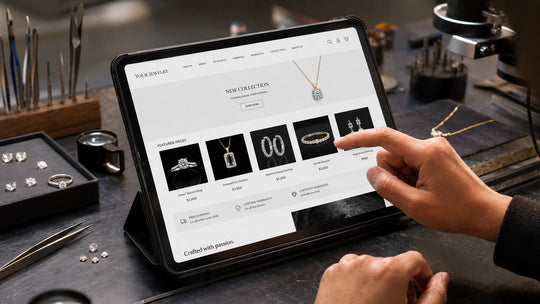
The pre-show catalog itself is built in the GemIQ App using the assets from these two tools. Every piece featured in the show is pre-loaded into a single, branded, digital catalog with prices, descriptions, and a clear buy action per piece. The catalog is ready to send the moment the show ends.
Two tools, one app, one 60 to 90 minute session for a 15 to 25 piece show. This is what makes weekly shows operationally feasible.
Part 2: The live show itself
The live show is the moment. Two capture setups matter here, and they run in parallel.
The primary camera captures the host. This is usually a phone on a tripod at eye level, sometimes a dedicated content camera for higher-production shows. The host talks to the audience, holds pieces, answers questions, calls out buyers by name.
The secondary capture rig is the close-up view of the piece itself. Most independent jewelers underinvest in this second camera. It is the difference between a live show that looks amateur and one that looks like a jewelry retail experience.

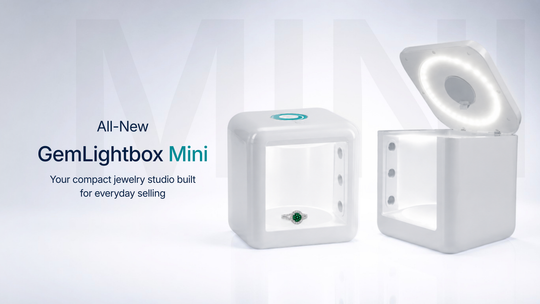
GemLightbox Max slots into the studio setup as the between-piece capture station. When a viewer asks to see a piece from a different angle, or requests a rotation to show the full profile, GemLightbox Max is the fastest way to produce that view on camera. The 360-degree Infinity Lighting produces consistent shadowless imagery in real time. The 2.5x larger capture space handles everything from small studs to statement necklaces without setup changes. Set it up next to the show host, and the audience gets the studio-quality view whenever a viewer requests it.
The show format that works for jewelry: 30 to 60 minutes, 15 to 25 pieces, priced range across three tiers (an entry-level piece to hook new viewers, a mid-range that most viewers can buy, and one or two hero pieces that create the aspirational moment). Each piece gets 90 to 180 seconds of airtime. The host closes each piece with a clear buy signal (link in bio, DM to purchase, comment "SOLD" to hold).
Part 3: After the show
The 40 to 70 percent conversion rate is not all realized during the live show. A meaningful percentage happens after, and the retailers who understand this are the ones running the channel most profitably.
Three things happen in the after-show window, in sequence.
The 24 to 48 hour follow-up. Viewers who hesitated live come back. Viewers who missed the show want to see the pieces. Viewers who partially watched want to revisit specifics. This is where the branded catalog built in Part 1 does its work. Send the GemIQ App catalog link in the post-show recap to your email list and in DMs to viewers who commented "interested" during the show. Engagement analytics show you which pieces each viewer spent time on, which informs the personalized follow-up conversation. Miss the 48-hour window and conversion drops sharply.
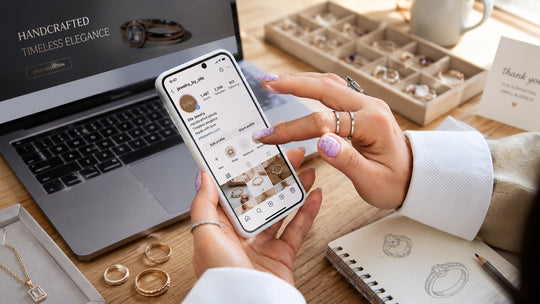
The 3 to 4 days of between-show content. The audience for the next show gets built between shows. Daily short-form vertical video using the sparkle hooks captured in Part 1. Behind-the-bench shorts. Colored stone education. GemLightbox Max produces the between-show catalog content alongside the pre-show prep, so one 60-minute weekly capture session feeds a full week of daily posts across ecommerce, email, and social. Each week's content grows the audience for the next live show. Week 1 sees 200 live viewers. Week 4 sees 800. Week 12 sees 2,500.
The lifestyle and model imagery that closes the ecosystem. Live commerce shows the piece in isolation. On a tray, in a hand. What the viewer does not see is the piece on a person, in a setting, in motion. GemStudio closes this gap. From the same product photos captured in Part 1, GemStudio generates hyper-realistic on-model imagery with one-click skin-tone variants for authentic representation, lifestyle setting imagery, and short-form videos that pair with the between-show social content and the post-show follow-up catalog.

The full workflow now looks like this. Capture the pieces with GemSparkle and GemCam Pro. Build the follow-up catalog in the GemIQ App. Run the live show with GemLightbox Max as the close-up studio station. Follow up with the branded catalog link. Layer in GemStudio lifestyle and model imagery to build the audience for the next show.
Three parts. Four GemIQ tools. One integrated live commerce ecosystem that produces the 40 to 70 percent conversion rate quoted at the top of this guide.
Independent jewelers who build this workflow this quarter will have a working live commerce channel by Q4, exactly in time for the highest-conversion months of the calendar year. The retailers who wait until October to start will spend Q4 building the audience while their competitors are converting it.
The channel is open. The workflow is repeatable. The tools are available.
The live commerce discipline is what turns the 40 to 70 percent conversion rate from a headline into a business.
Sources
-
Southern Jewelry News, 2026 industry coverage on live commerce conversion rates for jewelry retail — https://southernjewelrynews.com/
-
National Jeweler, Independent jewelry retailer social commerce and live shopping coverage — https://nationaljeweler.com/
-
INSTORE Magazine, Jewelry retail digital sales channels and 2026 conversion trends — https://instoremag.com/
-
JCK Online, Jewelry ecommerce and live commerce industry coverage — https://www.jckonline.com/
-
GemIQ, GemSparkle, GemLightbox Max, GemCam Pro, GemIQ App, and GemStudio product documentation — https://gemiq.com