Table of contents
-
Why the mid-year inventory check is the most consequential audit of your year
-
Decision 1: Re-price your inventory at current replacement cost
-
Decision 2: Identify dead stock and decide what to do with it
-
Decision 3: Lock your Q3 and Q4 inventory composition for the new market reality
-
Decision 4: Document every piece professionally for insurance and operations
-
Decision 5: Plan your catalog and content production cadence for the holiday season
-
What compounds if you make all five
Jewelry inventory management at the mid-year mark is the single most consequential audit of your year. The decisions made in June set the entire back-half of 2026. Q3 buy plans, Q4 holiday positioning, year-end margin, and the inventory you carry into 2027 all flow from what you decide this month.
Most independent jewelers skip the mid-year audit. Summer is slow, the holiday rush feels far away, and the instinct is to let inventory sit until back-to-school traffic picks up. By the time the audit happens (usually in September or October), the buying window for fresh holiday merchandise has narrowed and the SKUs that should have been cleared in July are now competing for shelf space with the new collection.
The operators who make the mid-year decisions deliberately, in June, are the ones who walk into Q4 with a clean catalog, a clear story, and a margin profile that holds.
Here are the 5 decisions every independent jeweler should make this month.
Why the mid-year inventory check is the most consequential audit of your year
Three structural factors make June the right moment.
Factor 1: Six months of real data is enough to see what's working. January through May gives you a meaningful sample of sell-through performance across every SKU. By June, you have actual movement data for the calendar year, not projections. SKUs that have not moved in 6 months are unlikely to move in the next 6 without intervention.
Factor 2: The buying window for Q3 and Q4 closes faster than you think. New merchandise ordered in mid-June arrives in August, hits the floor in September, and has roughly 90 days of holiday selling before year-end. Orders placed in July or August arrive too late. The buy decisions for the back half of the year are functionally a June decision.
Factor 3: The macro environment has changed faster than most catalogs. Gold above $4,500, lab-grown diamonds at 45% of US engagement ring purchases, the watch category converging with fine jewelry, lifestyle expansion at every major retailer. Most independent jewelers' catalogs were composed for a 2024 market. The June audit is the catch-up moment.
National Jeweler and INSTORE Magazine both ran mid-year operator coverage this month confirming the same pattern. The retailers who treated June as a pure operational maintenance month underperformed peers who used it as a strategic reset.
Five decisions follow. Each one builds on the previous. None of them take more than a week to make
Decision 1: Re-price your inventory at current replacement cost
Before any new buying decision, audit your existing inventory at current replacement cost.
Most independent jewelers run pricing on the landed cost from the original purchase. That number was set against 2024 commodity prices in many cases. With gold tracking above $4,500 per ounce and forecast to push higher through year-end, the cost to replace your current inventory is meaningfully higher than what you paid for it.
The audit is straightforward. Pull your top 50 SKUs by units sold over the last 12 months. For each one, calculate what the gold and stone content alone would cost to source today. Compare against current retail price. You will find three buckets:
-
Bucket A. Healthy margin even at today's replacement cost. Keep selling.
-
Bucket B. Margin compressed but positive. Raise the price, or accept the lower margin as a volume play. Decide deliberately, not by inertia.
-
Bucket C. Would lose money replacing the stock if sold tomorrow. Raise the price aggressively, melt the piece, or sunset the SKU.
This is a one-afternoon project for a small team. It is the single highest-leverage move in this entire decision set, because every other decision downstream depends on knowing what your real margin profile looks like at current prices.
Decision 2: Identify dead stock and decide what to do with it
Dead stock is any SKU that has not moved in 12 months or longer. Most independent jewelers carry between 15% and 30% of their total inventory as dead stock, often without realizing it. The pieces sit in the safe, in the back display case, on the website's deeper category pages. They appear in your inventory reports as assets. They function as liabilities.
The mid-year audit forces the decision. For every dead-stock SKU, pick one of three paths.
Path A: Deep-discount sell-through. Run a clearance event, mark down aggressively (30 to 50% off), and clear the inventory in 60 to 90 days. Captures any remaining cash value, frees up display space, and signals fresh merchandise to your existing customers.
Path B: Melt or scrap. For dead stock where the design has aged out and the metal value is meaningful (which is most of it at $5K gold), the melt path can recover 60 to 80% of the metal's current market value. The recovered metal funds your next custom commissions or new collection buys.
Path C: Restyle. Take dead-stock pieces back to the bench and rework them into current-style designs. A 2018 cluster pendant becomes a 2026 layered necklace component. Works best for pieces with quality stones in dated settings. Pairs well with custom commissions if the restyle is sold as a finished new design.
The wrong path is the unstated one. Dead stock sitting in the safe for another 12 months is dead stock that costs you cash, floor space, and the mental energy of pretending it might still move. Decide deliberately by July 15.
Decision 3: Lock your Q3 and Q4 inventory composition for the new market reality
Once your existing inventory is cleaned and re-priced, the Q3 and Q4 buy plan is the largest decision of the audit. Four sub-decisions sit inside this one.
Sub-decision 1: Lab-grown vs natural diamond mix. Lab-grown diamonds now account for more than 45% of US engagement ring purchases. If your current bridal inventory does not reflect that mix, the holiday buying window is the catch-up moment. The two-track catalog architecture (lab-grown as accessible everyday luxury, natural as enduring symbolic value) is now the operator default. Decide your bridal mix percentages and place orders by July 1.
Sub-decision 2: Gold-heavy vs gold-light design weighting. With gold above $4,500 and rising, thinner bands, diamond-heavy designs, and silver/platinum substitution all become more important to the catalog mix. Ring Concierge and other digitally-native brands have already shifted. The mid-year buy is when independent jewelers catch up.
Sub-decision 3: Lifestyle and accessory category posture. The 2026 JCK Lifestyle Pavilion signaled that traffic-driving non-jewelry categories belong in independent stores now. Make the in-or-out decision before the holiday buy. If in, allocate 5 to 10% of open-to-buy to lifestyle adjacencies (luxury candles, leather goods, fine paper, fragrance, small home objects). If out, document why and skip it cleanly.
Sub-decision 4: Watch category posture. Timepieces at Luxury and the broader watch convergence at JCK 2026 signaled the structural shift. Three viable postures: full watch program (4 to 8 brands), curated 1-to-2 brand strategy, or deliberate opt-out. Lock the posture before any holiday watch orders are placed.
The sub-decisions above are not theoretical. Each one has a sourcing deadline that closes faster than independents typically realize. The June audit is when the four-part Q3/Q4 buy plan locks in.
Decision 4: Document every piece professionally for insurance and operations
Once the inventory is cleaned, re-priced, and locked, the next move is to document everything. This decision is the bridge from inventory management to operations and from operations to security.
Three reasons documentation matters more in 2026 than it did in prior years.
Reason 1: Insurance recovery favors documented inventory. The Jewelers' Security Alliance 2025 crime report showed total dollar losses at $144.7 million across the industry. Claims on jewelry losses are notoriously contested. Operators who can produce dated, professional, specification-level documentation recover faster and at higher value than operators who hand over a spreadsheet and phone snaps.
Reason 2: Inventory documentation feeds every downstream content workflow. The same images that establish your insurance record become the foundation for your Q3 and Q4 catalog, your ecommerce listings, your email campaigns, and your social content. Documentation done well at the mid-year audit pays back across every content surface for the rest of the year.
Reason 3: The professional standard has shifted. Phone snaps on a glass counter are no longer adequate for insurance, for resale documentation, for custom-piece histories, or for the customer-facing record that high-end clients now expect. The bar has moved up. Independent jewelers who have not moved with it are exposed on multiple fronts.
The documentation workflow is straightforward. Every piece in current inventory gets a dated, true-color, multi-angle photo record. The professional standard is captured in studio (consistent lighting, true color, multiple angles, macro detail for hallmarks and identifying marks) and stored both locally and off-site. Most independent jewelers can document 50 to 80 SKUs per week with the right workflow. That makes the full inventory documentable inside the 30-day mid-year audit window.

Decision 5: Plan your catalog and content production cadence for the holiday season
The fifth decision is about how you actually sell the inventory you just bought, cleaned, re-priced, and documented.
Q3 and Q4 are the highest-conversion months of the calendar year for jewelry retail. Engagement season ramps in September. Holiday gift buying begins in October and peaks in mid-December. Year-end self-purchase momentum runs through New Year's. Independent jewelers who walk into August with a complete, polished, photographed catalog ready for daily content publishing outperform competitors who are still shooting new arrivals in November.
The production cadence required for the holiday season is meaningful. Most independent jewelers underestimate it. A realistic Q3/Q4 content output looks like this:
-
Ecommerce listings: 4 to 8 photos per new SKU, plus 1 to 2 videos. Every new arrival needs the full asset set within 7 days of receipt.
-
Email marketing: 2 to 4 sends per week from October through mid-December, each one requiring fresh imagery.
-
Social content: Daily short-form video on Instagram Reels and TikTok across the 90-day holiday window. Roughly 20 to 30 pieces of new content per week at peak.
-
Wholesale and custom catalogs: Branded share links for every bridal lead, every custom inquiry, and every press outreach. Each one is a polished, personalized digital catalog.
The production math is straightforward. At weekly output of 20 to 30 finished pieces of content, you need a capture and edit workflow that can sustain that pace without burning out the team. This is where the production stack decision matters.
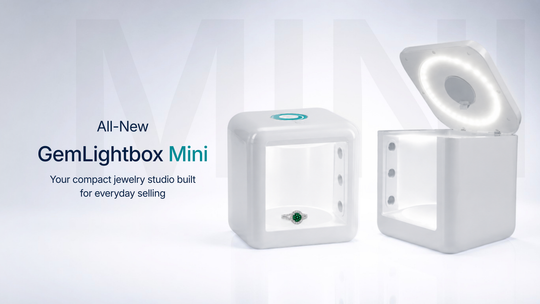
GemLightbox Max is the studio engine that handles the capture side of this workflow. The 2.5x larger capture space accommodates everything from individual rings to statement necklaces, layered bridal stacks, and watches. Infinity Lighting delivers 360-degree shadowless lighting via 12-point precision LEDs, so a junior team member produces consistent, on-brand assets without art-direction supervision. The Jewelry Intelligence AI handles one-click photo and video capture, writes product descriptions automatically, and uploads directly to Shopify. A 60-minute weekly capture session produces enough static and video content for a full week of daily posting, plus the static ecommerce assets, plus the wholesale-ready catalogs. The throughput is what makes the Q3/Q4 cadence achievable.
GemStudio handles the lifestyle and on-model imagery side of the workflow, which is the part most independent jewelers either skip or outsource at high cost. The traditional answer is a model shoot at $1,500 to $3,000 per 30-piece session with 4 to 8 week lead times. The math does not work for a holiday content cadence that needs lifestyle imagery on weekly new arrivals. GemStudio generates hyper-realistic on-model imagery from a single product photo, with one-click skin-tone variants for diverse representation across your audience. Built-in retouching handles the polish work. Operators using GemStudio report 40 to 60 percent reductions in content production time. For independent jewelers running a 90-day holiday cadence, that throughput delta is the difference between a complete catalog rollout and a half-finished one.

Used together, GemLightbox Max captures every new SKU in studio quality, and GemStudio extends each captured piece into the lifestyle and model variants required for Q3 and Q4 marketing. The mid-year audit is the right moment to lock the content workflow. Q3 production starts in August. The system has to be in place before then.
What compounds if you make all five
Five decisions. Each one builds on the previous. None take more than a week to make.
Run them all and three outcomes hold by year-end.
Margin holds at current commodity prices. Decision 1 prevents the silent margin erosion that happens when inventory pricing lags commodity prices. Decision 2 frees cash from dead stock. Decisions 3, 4, and 5 ensure the new inventory is priced, documented, and merchandised for the actual market.
Q4 catalog goes to market complete and polished. Decisions 3, 4, and 5 together produce a holiday catalog that is photographed, described, segmented, and ready for daily publishing by mid-August. Independent jewelers who walk into September with a complete catalog outsell competitors who are still shooting new arrivals in November.
Operational risk drops. Decision 4 ensures every piece in inventory is documented for insurance recovery, restyle history, and customer-facing records. The professional standard the industry has shifted to is now your default, not your aspiration.
The mid-year audit takes 3 to 4 weeks of focused operator attention. It pays back across the remaining 6 months and into 2027.
Five decisions. One month. The audit starts this week.
Sources
-
National Jeweler, 2026 mid-year jewelry retail industry coverage — https://nationaljeweler.com/
-
INSTORE Magazine, Independent jewelry retailer operations and inventory coverage — https://instoremag.com/
-
AOL News (via Stacker / BriteCo), Lab-grown diamonds now cost 73% less than natural diamonds. What that means for buyers in 2026 — https://www.aol.com/news/lab-grown-diamonds-now-cost-190021227.html
-
Jewelers' Security Alliance, 2025 Annual Crime Report — https://jewelerssecurity.org/
-
JCK Online, JCK Las Vegas 2026 show coverage and post-show industry trends — https://www.jckonline.com/
-
GemIQ, GemLightbox Max and GemStudio product documentation — https://picupmedia.com