Ask around online and you will find a steady complaint about jewelry photography: the stone looked deeper, the band looked wider, the gold looked warmer. Buyers have learned to discount what they see, and that skepticism costs every seller in the category, including the honest ones.
The fix is available and mostly technical. This covers what creates distance between a photograph and the piece in hand, what an honest listing shows, how color accuracy works in practice, what federal guidance already requires of online sellers, and what a buyer should be able to ask for.
Why Do Jewelry Photos Look Different From the Piece That Arrives?
Four things create distance between a photograph and the piece in hand: color shift from lighting choices, scale distortion from framing, saturation added in editing, and a single flattering angle standing in for the whole object. Each one is a production decision rather than an accident, which means each one has a correction.
Color shift. A warm light source pushes yellow gold warmer and can lift a pale stone toward a richer tone. The camera records what the light gives it.
Scale distortion. A macro lens close on a solitaire fills the frame with a stone that measures four millimeters. Absent a reference, the buyer reads the frame rather than the measurement.
Editing saturation. Pushing vibrance makes a sapphire read deeper and an emerald read greener. The image becomes more attractive and less accurate at the same time.
The single angle. One three-quarter hero showing the piece at its best leaves the gallery, the shank profile and the setting height unseen.
The commercial cost is measurable. Around 22% of ecommerce returns happen because the product looked different in person than it did online, and Shopify puts online return rates near 20 items per 100 sold against 15.8% for retail overall (Shopify). In jewelry, where a single return can carry hundreds of dollars in margin, accuracy pays before it earns any goodwill.

What Should an Honest Jewelry Listing Show?
Six things let a buyer form an accurate picture: true color under neutral light, a scale reference, the profile, macro detail, motion, and stated measurements. Deliver those and the piece arriving matches the piece expected.
True color under known lighting. Neutral light for white metals, warm for yellow and rose gold, with the setting consistent across the catalog so a buyer comparing two pieces compares the pieces rather than two lighting setups.
A scale reference. A hand, an ear, or a measurement callout. This is the single most common gap, and the one that generates the most disappointment.
The profile. Setting height, gallery construction and shank thickness. A buyer who sees the profile understands how the piece sits.
Macro detail. Prong placement, pavé seats, hallmarks, engraving. Showing the workmanship closely signals confidence in it.
Motion. A rotation shows how light behaves across the piece as it turns, which is what a buyer would do holding it.
Stated measurements. Band width, stone dimensions, total length, carat weight, in text where they can be read rather than inferred.
A useful test: if a buyer could learn everything from your listing that they would learn holding the piece for thirty seconds, the listing is honest.
How Do You Photograph Gemstone Color Accurately?
Accurate color comes from a known light source, a locked white balance, and a capture device built to record color faithfully rather than to flatter it. Colored stones are where this matters most, because the difference between  one blue and another is the difference between two price points.
Three practical controls:
Use a light source with a high color rendering index. Values above 90 are the working standard for color-critical work, since a low CRI source can render reds and warm tones inaccurately even at the correct color temperature.
Lock white balance rather than leaving it automatic. Auto white balance adjusts per frame, which means the same ruby photographed twice can produce two different reds.
Capture with a device built for the job. GemCam Pro, the dedicated jewelry camera in the GemIQ range, captures true color and fine detail in one click. On colored stone inventory this is the difference between a listing a buyer trusts and a conversation that starts with a question about the photo.
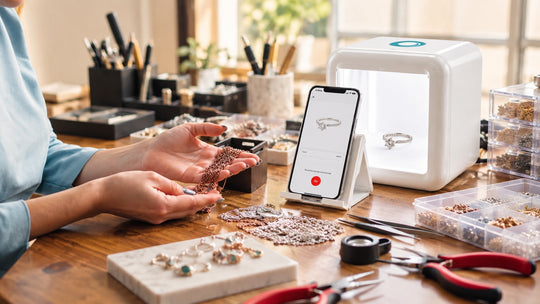
It pairs with GemLightbox Pro, the plug-and-play AI lightbox, or GemLightbox Max, the flagship with 2.5x the capture area, both of which hold the lighting conditions steady so the color your camera records stays the same across the session.
Then hold one export preset through the GemIQ App so the file reaching your site, your feed and your marketplace listing carries identical color. A piece that reads one way on your Shopify page and another on Etsy undoes the work.
What Does the FTC Require Jewelry Sellers to Disclose Online?
The FTC Jewelry Guides at 16 CFR Part 23 make it unfair or deceptive to misrepresent the type, grade, quality, size, weight, cut, color, character, treatment or any other material aspect of a jewelry product, and they require that disclosures appear in the product description whenever a buyer purchases without personally viewing the item (eCFR). That second clause covers every online listing you publish.
Two points worth sitting with.
Color is named explicitly. The guidance lists color alongside weight and cut as a material aspect. An image that materially changes how a stone's color reads sits inside the same territory as a description that misstates it.
Online selling raises the bar rather than lowering it. Because the buyer has no chance to view the piece, the guidance places the disclosure burden in the listing itself. Treatments, enhancements and lab-grown origin belong in the description rather than in a hover state or a footnote.
The Guides also ask that qualifying language be understandable to an ordinary buyer. Trade terms like clarity-enhanced or oiled read clearly inside the industry and can pass over a first-time buyer entirely, so plain wording does more work than technically correct wording.
None of this is burdensome for a seller already photographing accurately. It is largely a description of good practice with federal backing behind it.
What Should a Buyer Be Able to Ask a Seller For?
Every request below is reasonable, and a seller photographing well can answer all of them from assets already on hand. Sellers reading this can treat it as a specification. Buyers can treat it as a checklist.
| The ask | Why it matters | What a prepared seller sends back |
|---|---|---|
| A photo under neutral daylight | Reveals the true metal tone and stone color | An existing catalog frame, since the lighting is already known and recorded |
| The piece on a hand or ear | Settles scale in one glance | A worn frame from the listing set |
| Measurements in millimeters | Numbers travel where images distort | Band width, stone dimensions, total length, already in the listing |
| A profile view | Shows setting height and how the piece sits | Slot three of a standard shot sequence |
| A macro of the setting | Shows prong placement and seat quality | Slot four of a standard shot sequence |
| A video of the piece turning | Shows light behavior as it moves | The 360 rotation captured with the stills |
| Confirmation of treatments and origin | Material to value and to care | Stated in the description already, per FTC guidance |
| An unedited frame | Confirms saturation stayed honest | Straight from capture, minimal processing |
A seller who answers those quickly is telling you something about the piece. A seller who finds them difficult is telling you something too.
For sellers, the useful realization is that every row above comes from a shot sequence you would run anyway. The scale frame is the one most often missing, and GemStudio, the AI software that produces model and lifestyle visuals from a single product photo, generates worn frames with skin tone selection built in from assets already captured. Listings carrying lifestyle visuals see around 22% fewer returns, which is the same problem this whole post is about, measured from the other end.

Sources
- Electronic Code of Federal Regulations, 16 CFR Part 23, Guides for the Jewelry, Precious Metals, and Pewter Industries — https://www.ecfr.gov/current/title-16/chapter-I/subchapter-B/part-23
- Shopify, Ecommerce Returns Management: How To Reduce Returns — https://www.shopify.com/enterprise/blog/ecommerce-returns
- Federal Register, Guides for the Jewelry, Precious Metals, and Pewter Industries, 2018 revision — https://www.federalregister.gov/documents/2018/08/16/2018-17454/guides-for-the-jewelry-precious-metals-and-pewter-industries
- Corso, The most common ecommerce return reasons, reporting Invesp data — https://www.corso.com/post-purchase-resource-center/the-most-common-ecommerce-return-reasons