Every jeweler has a dedicated photography workflow for the big moments. New collection shoots. Ecommerce catalog production. Wholesale asset libraries. Those live in the studio, on GemLightbox Pro or GemLightbox Max, on the weekly capture schedule that feeds ecommerce, email, and social.
But most jewelry photography moments are not the big ones. They are the small ones. The pieces that come across the bench mid-repair, the customer question at the counter, the vintage piece that walked in through the door 20 minutes ago. These are the everyday selling moments, and they happen outside the studio. Most of them get missed.
Here are 8 you are probably missing right now, and the simple fix that catches all of them.

Why the best jewelry photography moments happen outside the studio
Jewelry sales in 2026 do not follow a studio schedule. They follow the customer. A repair is finished at 2 pm and the customer wants to see it before pickup at 5. A supplier stops by with three loose stones that need to be shown to a client tonight. A vintage piece comes in for consignment and needs to be on the website by Friday. None of these moments wait for the studio to open on Tuesday morning.
The retailers who capture these moments in real time convert more of them into sales. The retailers who defer capture to the next studio session lose the momentum, and often lose the sale.
The gap is not photography talent. It is proximity. Your dedicated studio is set up for scheduled production. It is not set up for a piece that showed up at 3:47 pm on a Thursday.
The 8 everyday moments you're probably missing
Moment 1: The new arrival that walked in an hour ago. Your supplier drops off a fresh parcel. You look at the pieces, know exactly which one your regular customer will want, and then set the piece aside "for the next studio session." By Tuesday, the customer has bought something similar somewhere else. The pieces new to your inventory need to be capturable within the same hour they arrive.
Moment 2: The custom piece just off the bench. Your jeweler finishes a custom ring at 3 pm. The customer scheduled to pick it up at 5. You want to send them a preview photo so they can see it before they arrive, but the studio is on the other side of the shop and setup takes 20 minutes. The preview never gets sent, the customer walks in with no anticipation built up, and you lose the emotional moment that would have supported the follow-on referral.
Moment 3: The customer's own piece coming in for repair. A customer brings in a piece for repair, resizing, or stone tightening. Documenting the piece professionally before you start work is protective for both parties and reassuring to the customer. Most jewelers use a phone snap. Most phone snaps do not read the piece accurately enough to serve as a real record.
Moment 4: The counter conversation with a considering customer. A walk-in is considering a piece at the case but wants to think about it. They ask you to send them a photo they can look at later. You take a snapshot with your phone, they receive it in bad lobby lighting an hour later, the piece looks nothing like it did in the store, and they never come back.
Moment 5: The repair reveal. A customer's heirloom piece has just been restored. The before-and-after story is the strongest content you can produce all week. Static ecomm photos will not capture it. Studio production is not designed for it. The reveal moment happens once, in the shop, when the piece comes off the bench.
Moment 6: The trade-show pickup back at your desk. You attended JCK, IJO, or a regional buying show. You brought back 30 loose stones and 15 finished pieces. Your dedicated studio schedule cannot process the pickup for two weeks. Your competitors who pick up new inventory faster start posting theirs while yours sits in the safe.
Moment 7: The consigned or estate piece before it hits the catalog. A private client brings in a piece for consignment. The piece needs to be photographed, described, and listed. Right now, the workflow says: wait for Tuesday studio session, process it there. The client thinks the piece is already listed. It sits for 6 days before it actually goes live.
Moment 8: The customer follow-up on a piece they saw yesterday. A customer visited the store yesterday, looked at three pieces, and told you they wanted to think it over. Today they text: "Can you send me a photo of the sapphire one?" The right answer is to send a professional-quality shot within the hour. The realistic answer for most jewelers is a phone snap that does not do the piece justice.
Every one of these moments happens somewhere between the counter, the bench, the desk, and the customer follow-up. None of them happen in the dedicated studio. All of them cost real revenue when they get missed.

The compact fix that catches every moment
Your dedicated studio setup is not the problem. GemLightbox Pro and GemLightbox Max are built for high-throughput studio production, and they do that work exceptionally well. The problem is that the studio is not everywhere in your business. It is in one room, running on a schedule.
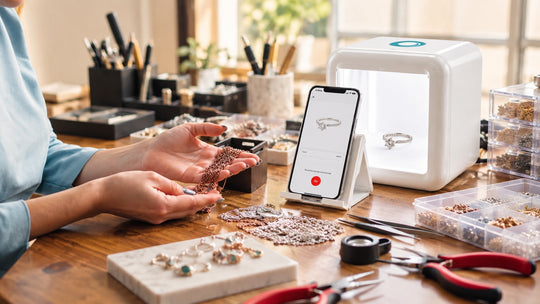
GemLightbox Mini is the added tool that lets the studio-quality workflow follow the moments the studio itself cannot. Compact enough to sit permanently on the bench, on the counter, in a home office, or on the desk where customer-follow-up conversations happen. One-tap capture. 360 video. Sparkle lights. AI descriptions, background cleanup, Shopify upload, and branded share pages built in. Every capture matches the visual standard of your studio production because the software stack is the same.

The workflow that catches all 8 moments looks like this. Your dedicated studio (Pro or Max) runs the scheduled catalog production, the ecommerce assets, the wholesale libraries. GemLightbox Mini lives where the everyday moments happen. New arrival mid-day capture, customer-follow-up shot in 30 seconds, repair reveal before the customer walks in, consignment piece listed the same day it comes in.
Two capture surfaces. One workflow. Every moment caught.
Independent jewelers who add Mini to their existing studio setup will spend the rest of 2026 catching moments they used to lose. The retailers who wait for the moments to fit the studio schedule will keep losing the ones that do not wait.
The moments are yours to capture.