The biggest jewelry personalization trend of 2026 isn't a design style — it's a sales pattern. By most measures, 2026 has been a strong year for jewelers. Revenue from jewelry, watches, and other fine gifts climbed roughly 20% year-over-year in early August, according to Rapaport, and JCK's mid-year show recap reported double-digit attendance growth alongside some of the strongest retailer engagement in recent memory. Exhibitors walked the floor with full appointment books. Retailers went home with healthier inventory positions than they've had in years. Heading into the second half of 2026, the mood across the industry is, for once, genuinely optimistic.
But if you look closer at why business is good, there's a catch — one that's quietly reshaping how jewelers need to run their online stores.
Why Jewelry Personalization Is Driving 2026 Sales
It's not lab-grown diamonds. It's not gold, despite record-high metal prices dominating headlines. The category actually driving 2026's momentum is personalization: engraving, remounts, birthstone settings, and jewelry tied to specific milestones — anniversaries, graduations, new babies. Layered and stackable pieces are having a moment too, with yellow gold chains and stackable bracelets pulling in both younger, self-purchasing customers and established loyal buyers.
This is good news for revenue. It's a harder problem for your website.

Every Personalization Option Is a New Listing
A single ring design isn't one product anymore. It's a ring in three metal finishes, five engraving styles, two stone options, and four sizes — each of which a customer expects to see clearly before they buy. A "stack" isn't one photo either; it's dozens of plausible combinations a shopper wants to visualize on their own wrist before checking out.
For an independent jeweler, that math gets ugly fast. The old model — book a photographer, shoot the collection, edit for a few weeks, upload — was never built for this many variants per SKU. Jewelers who try to keep up the old way end up either skipping personalization options on their site (and losing the sale to a competitor who shows them) or burning through margin on reshoot after reshoot for what is, physically, the same piece of jewelry.
Solving the Jewelry Ecommerce Customization Bottleneck
The constraint isn't demand. It's capture and publishing speed. This is exactly where GemIQ's workflow was built to close the gap.
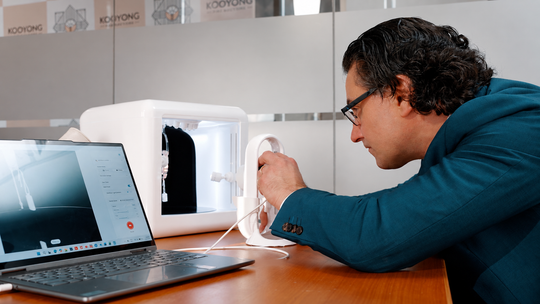
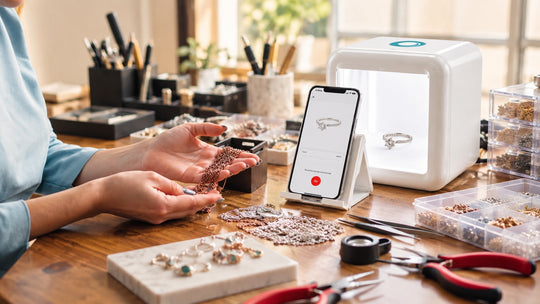
GemLightbox Max handles the capture side. It's built for the exact reality of personalization-driven inventory — same base design, different finish, different engraving, different stone — letting a jeweler photograph and film variant after variant in-house, in minutes, without booking studio time or a photographer for every configuration. Two integrated turntables mean 360° rotating video comes standard, so customers can actually see how a stack sits or how light hits an engraved detail, not just a static product shot.

From there, the GemIQ software takes over the part that used to eat weeks: AI background removal, AI-generated product descriptions for each variant, and one-click publishing straight to Shopify. A jeweler can go from "customer requests a new engraving option" to "live, purchasable listing" in one sitting — no separate editing software, no waiting on a freelancer, no gap between what's trending on the sales floor and what's actually visible in the online store.
That's the real unlock in a personalization-driven market: it's not enough to offer more options. Customers need to see them, clearly, before they'll commit to a purchase they can't try on. Jewelers who can capture and publish variant content as fast as their customers are asking for it are the ones positioned to actually capture this year's growth — not just read about it in an industry report.
The Bottom Line
2026 is shaping up to be a good year for jewelry — but "good year" and "growing sales" aren't automatic. The retailers who benefit most from the personalization and stacking trends will be the ones whose websites can keep pace with how many variations a modern jewelry customer now expects to see. Capture speed and publishing speed have quietly become as important to this year's growth as sourcing and inventory ever were.