Rio Tinto's Diavik Diamond Mine officially ended production on March 24, 2026, closing 23 years of continuous operations that produced more than 150 million carats of rough diamonds from beneath Lac de Gras in Canada's Northwest Territories. Rio Tinto will polish and sell the final production through 2026 and beyond, but the mine itself is done. Closure activities extend to 2029.
For most media coverage, the story is the mine. The Indigenous partnerships, the economic legacy for the Northwest Territories, the engineering feat of returning a diamond mine to reclaimed land. All meaningful. None of it is what independent jewelers actually need to think about.
The operator question is different. What does it mean for your natural diamond inventory, your sourcing conversations, your customer story, and your visual content strategy when one of the world's most iconic natural diamond mines permanently exits production?
Here is what independent jewelers should actually take from it.
The natural diamond story just got a new proof point
The natural diamond category has spent the last three years repositioning around provenance, scarcity, and enduring value. Lab-grown diamonds at 45 percent of US engagement ring purchases forced the shift. Natural diamond marketing (Desert Diamonds, the Natural Diamond Council's provenance campaigns, De Beers' branded natural programming) has been building toward a specific story: this stone came from a specific place, with a specific origin, that will not exist again.
Diavik just gave that story its most tangible proof point yet.
For 23 years, Diavik produced diamonds with a documented Canadian provenance, ethically sourced under some of the strictest environmental and labor standards in the industry. Diavik diamonds were known specifically for their exceptional ice-white clarity and their traceable origin. That production has now ended forever. Every Diavik diamond currently in a jeweler's inventory, or being polished by Rio Tinto through the end of 2026, is now finite. The supply is closed.
This is not a marketing narrative your brand has to invent. It is the actual reality of the category. And it matches almost perfectly with the "enduring value" story natural diamonds have been repositioning around.
Independent jewelers who already carry Diavik or other Canadian-origin natural diamonds are sitting on inventory that just became measurably harder to replace. Independent jewelers who do not carry Canadian-origin stones may want to consider whether that changes for the second half of 2026 and into 2027.
What this means for your sourcing and inventory
Diavik was one of three producing diamond mines in the Northwest Territories. The Gahcho Kué mine (De Beers and Mountain Province Diamonds) and the Ekati mine (Burgundy Diamond Mines) remain in operation. But Diavik's exit tightens the supply of Canadian-origin natural diamonds meaningfully, and every retailer selling in that category is going to feel the effect over the next 18 to 24 months.

Three specific sourcing implications for independent jewelers.
Implication 1: Canadian-origin natural inventory becomes a differentiator. Retailers who can point to specifically-sourced Canadian stones (Diavik legacy inventory, Gahcho Kué, Ekati) have a story that competitors selling generic natural diamonds cannot match. The origin becomes a real premium justifier, not a marketing overlay.
Implication 2: The natural vs lab-grown conversation gets sharper. A customer choosing between a natural diamond and a lab-grown diamond is choosing between two products with fundamentally different scarcity profiles. Diavik's closure makes that difference concrete. Lab-grown production expands. Natural production contracts. Both stones are beautiful. Only one is finite.
Implication 3: Provenance documentation becomes an inventory asset. If you carry stones with specific origin certificates (Kimberley Process, Canadian Diamond Code of Conduct, GIA origin reports), the documentation itself is now a valuable part of the inventory story. Independent jewelers who have not been asking their suppliers for origin documentation should start.
None of this changes overnight. Diavik-produced diamonds will still be in the wholesale market for years as Rio Tinto polishes and sells remaining production. But the direction is now set, and the retailers who position for it early gain the storytelling advantage.
The customer conversation just got easier
The provenance and scarcity story has been the hardest part of the natural diamond sales conversation because it required the customer to trust the marketing. Diavik's closure gives that conversation a specific, verifiable, news-anchored proof point.

The sales-floor script now writes itself. A customer asks why a natural diamond costs more than a lab-grown at the same specs. The answer is now: because natural diamonds have a specific, finite origin, and that supply is contracting. One of the world's most respected natural diamond mines just permanently closed this year. The stone in this ring came from a specific place that no one can replicate. That is what you are paying the premium for.
This lands with customers in a way that abstract scarcity arguments never did. It also opens the door for the deeper provenance conversation: origin certificates, Canadian sourcing, the specific mines still in operation, the specific characteristics that identify a Diavik or a Gahcho Kué diamond versus a generic natural stone.
Independent jewelers who train their sales teams on the Diavik-anchored story over the next 30 days will see a measurable close-rate lift on natural diamond bridal and hero pieces. The story is fresh, the customer is receptive, and the news anchor gives the conversation the credibility it has been missing.
The visual content that has to support the story
A tighter natural diamond story only works if your visual content actually delivers it. A customer who reads about the finite Canadian origin, then lands on an ecommerce product page with a phone-snap photograph and a flat description, will not feel the premium. The visual asset has to match the story the sales floor is telling.
Two capture surfaces handle this workflow across a typical independent jewelry operation.
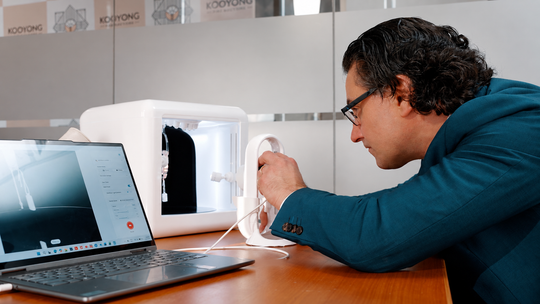
GemLightbox Max as the dedicated studio. For the scheduled catalog production of natural diamond hero pieces, GemLightbox Max is the studio. 2.5x larger capture space handles engagement rings, bridal stacks, and statement pieces without setup changes. Infinity Lighting delivers 360-degree shadowless imagery via 12-point precision LEDs, so the natural diamond reads in true color with the full brilliance the customer needs to see. Direct Shopify upload from the studio moves the captured asset from capture to live ecommerce listing in the same workflow. This is where the hero natural diamond pieces get their sales-floor-quality digital presence.

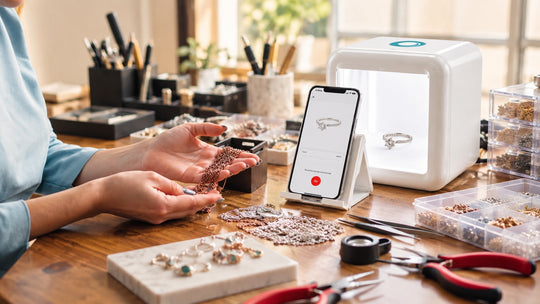
GemLightbox Mini at the bench and counter. For the everyday capture moments, GemLightbox Mini is the added tool that lives at the bench, on the counter, or wherever the moment happens. A customer brings in a Diavik-legacy piece for restyling. A bench jeweler finishes a natural diamond custom setting. A supplier drops off three new Canadian-origin stones that need to be documented for the safe. All of these moments happen outside the dedicated studio, and GemLightbox Mini captures them at the same visual quality standard as the studio does its scheduled work. Mini also supports direct Shopify upload, which means the bench-captured natural diamond piece can go live on the ecommerce catalog the same afternoon it was documented.
Both units share the GemIQ App workflow layer. GemBrush handles the cleanup and retouching that makes every captured asset publish-ready without a separate editor. AI-generated descriptions handle the initial copy for each stone. Branded collections and share pages let you build a curated catalog of your Canadian-origin natural diamond inventory and send it to a bridal customer in one branded link. The customer opens a professional experience, not a text thread. The engagement data tells you which stones they spent time on, which informs the follow-up conversation.
The workflow closes the loop between the sales-floor story and the digital asset. A customer hears about the finite Canadian origin. They ask for photos. They receive a branded catalog with true-color, cleaned, professionally documented stones from your Canadian-origin inventory. The story and the visual match. The natural diamond premium becomes credible on every surface.
The window that just opened
Diavik's closure is a permanent, one-time news event. The market conversation around it will run through the rest of 2026 and into 2027. Independent jewelers who lean into the story now, in the middle of the news cycle, gain a positioning advantage that will hold for years.
The move is not to change what you already do. It is to align the natural diamond conversation you were already having with the news anchor that just landed on every jeweler's desk this year.
Canadian-origin inventory becomes a differentiator. The provenance conversation gets sharper. The customer question about natural versus lab-grown finally has a specific, verifiable answer. And the visual content workflow from capture to Shopify to branded customer share supports the whole story.
The window is open. The natural diamond conversation is easier to have this week than it was last month.
The independent jewelers who use it are the ones who will still be telling the story in 2028.
Sources
- Rio Tinto, Rio Tinto's Diavik diamond mine delivers its final production — https://www.riotinto.com/en/news/releases/2026/rio-tintos-diavik-diamond-mine-delivers-its-final-production
- JCK Online, What Will Happen to the Final Diavik Diamond? — https://www.jckonline.com/editorial-article/happen-final-diavik-diamond/
- Gemporia, Canada's Diavik Diamond Mine Officially Closes — https://www.gemporia.com/en-gb/gemology-hub/article/2924/canadas-diavik-diamond-mine-officially-closes/
- Government of Northwest Territories, Premier, Ministers respond as Diavik closure signals next chapter for NWT economy — https://www.gov.nt.ca/en/newsroom/premier-ministers-respond-diavik-closure-signals-next-chapter-nwt-economy
- National Jeweler, Diavik Diamond Mine closure coverage and industry reaction — https://nationaljeweler.com/
- GemIQ, GemLightbox Max and GemLightbox Mini product documentation — https://gemiq.com